


About Andrew
The person and experience behind Paths to Presence
My work brings together more than fifteen years of Enneagram study with pastoral ministry, hospital chaplaincy, healthcare peer support, contemplative practice, and years of accompanying people when easy answers were no longer enough.
I have spent much of my professional life in places where easy answers are not especially useful
Before Paths to Presence became a practice, much of this work was already taking shape in my life.
I have served as a pastor, a hospital chaplain, and a program coordinator supporting healthcare professionals carrying burnout, moral distress, grief, and the cumulative weight of caring for other people. I have sat in family meetings when treatment options were running out, in rooms after devastating diagnoses, and with healthcare workers trying to make sense of experiences they could not simply leave at work.
Those moments rarely came with a clean explanation. People did not need me to tell them that everything would be okay or offer a lesson before they had enough room to understand what had happened. More often, they needed someone willing to stay present when the usual answers were not working.
What the Enneagram actually gave me, in those moments, was new language, a way of naming what people (myself included) automatically reach for when there's no answer available.
Fifteen years later, it's still the work I care about most.

Where the Enneagram became real
I first encountered the Enneagram more than fifteen years ago and have continued studying it across several traditions and approaches. I value the theory, history, and complexity of the system. But most of what I understand about the Enneagram was not formed only through books, workshops, or classrooms.
It was tested in hospital hallways, difficult conversations, helping relationships, and seasons when people were trying to live inside a reality they had not chosen.
I have watched thoughtful, capable, and caring people become more rigid, more avoidant, more task-focused, or more reactive when stress overwhelmed their usual flexibility. I have seen hope sustain people through deeply painful experiences. I have also seen hope offered so quickly that pain had no room to speak. I have seen competence become an expression of love, keeping families and teams moving through a crisis. I have also seen competence become a way of keeping the crisis from touching the person holding everything together. I have seen emotional intensity reveal truths that everyone else was trying to avoid, and I have seen that same intensity become exhausting when the alarm could no longer turn itself off.
Every strategy carries wisdom.
The trouble begins when the strategy becomes compulsory.
That is one reason I return so often to the Harmonic Triads. They offer a practical way to understand what we reach for when reality becomes disappointing, painful, uncertain, or unresolved. Some of us brighten or reframe. Some organize and manage. Some intensify or confront. None of those responses is inherently wrong. Each may be exactly what a moment needs.
The work is learning to notice when a familiar response is serving the moment and when it has started running us.
A spirituality spacious enough for questions
I don't assume where anyone is in their spiritual life, because I know what it's like for that to change.
I grew up in evangelical Christianity, trained as a minister, and spent years in church ministry before moving into hospital chaplaincy. That shift changed how I show up in a room. Chaplaincy placed me alongside people from many religious traditions, and people who wanted nothing to do with religion at all. It taught me to listen for the language, beliefs, and experiences through which each person actually makes meaning — rather than bringing my own answers into someone else's room.
My own spiritual life has continued to change since then. Today it draws from contemplative Christianity, Buddhist wisdom, mindfulness, psychology, and more than seven years of receiving spiritual direction myself. I know what it's like to hold questions without rushing them toward certainty, because I've had to.
That's the posture I bring into every session. I'm equally comfortable with someone whose faith is steady and someone whose beliefs are actively shifting, whose old spiritual language no longer fits, or who's simply asking what still feels meaningful. You do not need to identify with a particular religious tradition to work with me. Spiritual questions are welcome here, but never assumed, and I won't impose spiritual language where it doesn't belong.

The Enneagram gives us language without giving us a verdict
I continue using the Enneagram because it offers something I have not found in many other personality systems: language for the motivation and attention operating beneath behavior.
Behavior tells us what someone did. The Enneagram invites us to become curious about why that response made sense to them.
It's a small shift in wording, yet it changes the whole conversation.
There is a significant difference between saying, “You care more about your goals than you do about other people,” and recognizing, “When achievement feels connected to my value, I may minimize emotions in order to keep moving.” The first is a character judgment. The second gives us something we can observe, understand, and work with.
The Enneagram can help us speak more honestly without making that honesty a weapon.
It also gives us another way to relate to ourselves. Once we begin noticing a pattern, it is easy to turn the Enneagram into another tool for self-criticism. We identify the reaction, avoidance, over-functioning, or compulsion and immediately decide we have failed at our growth work.
My interest is in helping people recognize what's already happening, understand what a pattern is trying to accomplish, and decide whether that response is what the moment actually needs - becoming a 'better' version of a type was never the goal.
The Enneagram does not put you in a box.
It can help you notice the box you have already been standing in, as well as ways to get out.
How I approach this work
-
Curiosity without judgment
A pattern is easier to understand when we stop treating it as evidence that something is wrong with us.
Our strategies did not emerge from nowhere. They helped us find some sense of connection, safety, competence, identity, or stability. Before asking a pattern to change, I want to understand what it learned to do and why it still believes that response is necessary.
-
Presence before fixing
Not every difficult experience needs to be quickly solved, reframed, or transformed into a lesson.
Sometimes the first task is acknowledging what is here. Presence gives grief, uncertainty, disappointment, and spiritual questioning enough room to be experienced without allowing them to become the whole story.
-
Experience before labels
Your type matters only when it helps you recognize what is happening in your actual life.
I am less interested in whether you can describe your type correctly than in whether you can notice where your attention goes during a difficult conversation, what happens inside you when plans change, or which familiar strategy takes over when you feel uncertain.
-
Choice rather than prescription
No two people arrive with the same question, and the same practice will not serve every person in every season. We begin with what is actually happening and pay attention to what the moment might need.
My role is not to generate answers for you. It is to help you listen more carefully to what is already happening.
Formation, credentials, and influences
Formal training and professional formation
✓ Certified Narrative Enneagram Teacher
✓ Accredited Professional with the International Enneagram Association
✓ Ordained minister
✓ Founding Vice President of Enneagram Texas, an affiliate of the International Enneagram Association
Influences on my work
My understanding of the Enneagram has been shaped by the Narrative tradition, Suzanne Stabile, the Riso-Hudson lineage, Sandra Maitri, Awareness to Action, and many other teachers and practitioners. I completed my teacher certification training through The Narrative Enneagram, founded by Helen Palmer and Dr. David Daniels
The Awareness to Action approach has become an important recent influence in the way I understand the instinctual biases, adaptive strategies, blind spots, communication, and what happens when a useful strategy becomes overused.
My broader approach is also shaped by mindfulness practice, contemplative spirituality, chaplaincy, spiritual direction, psychology, and the many people who have trusted me enough to let me sit beside them during difficult seasons.
Continuing the conversation
I have had the opportunity to join several podcast conversations exploring the Enneagram, contemplative practice, personal experience, and meaning-making.
The Enneagram Journey
with Suzanne Stabile
The Couch Next Door
with Candice Fraser
Words from Silence: A Contemplative Podcast
with Lindsay O’Connor
Early Access, an Around the Circle podcast
with Katie Whitlock
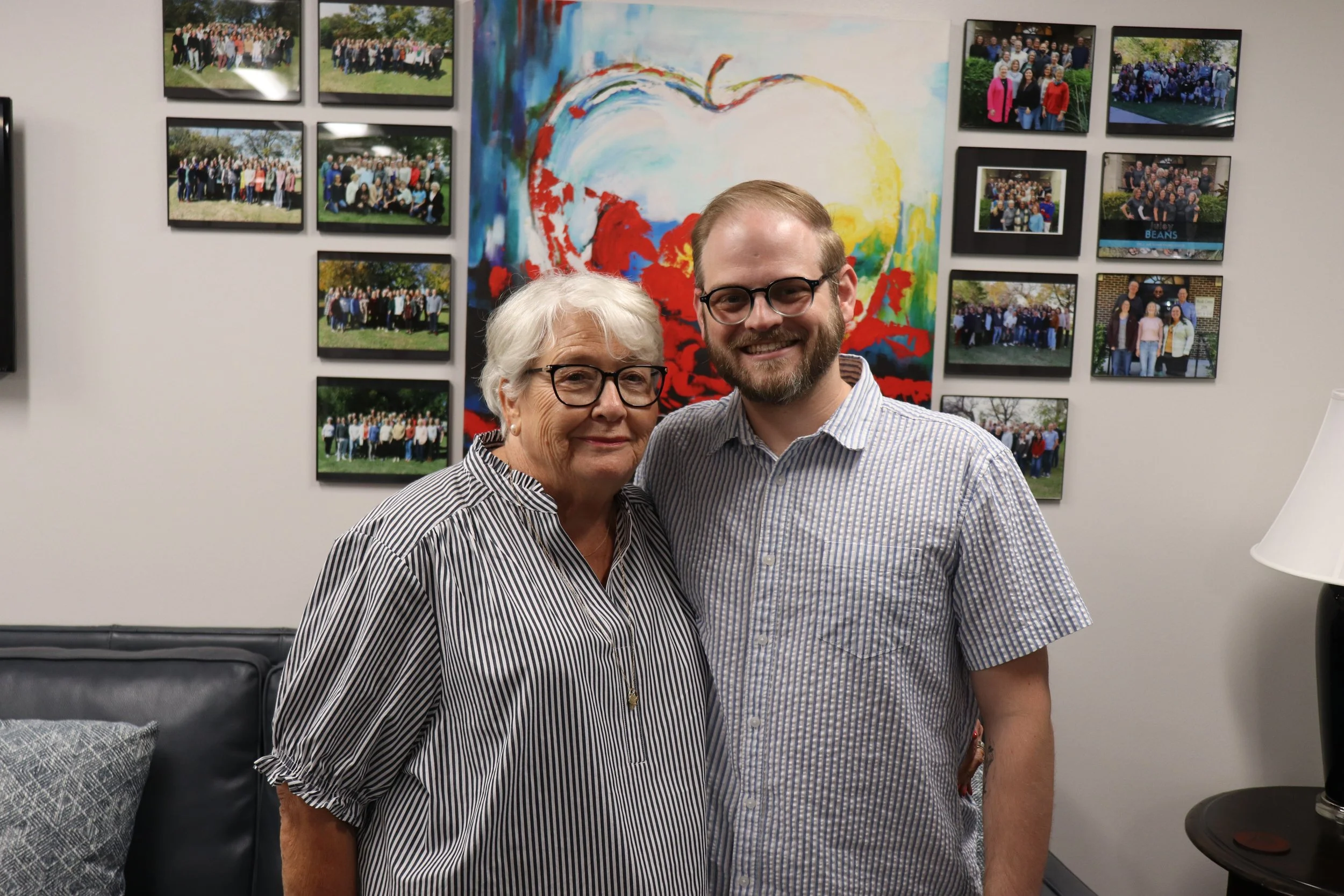
When I'm not working, I'm probably rewatching Ted Lasso or The Office for the tenth time, reading a mystery novel (Louise Penney and Dan Brown are two of my favorites), whatever my special interest is at the time, or looking for an excuse to get back to my happy place: the mountains and forests of the PNW. I live in the Dallas-Ft Worth metroplex with my wife, son, and a dog we affectionately call our sour-patch pup.
About the Paths to Presence logo

The Paths to Presence logo is based on a labyrinth.
Unlike a maze, a labyrinth has one continuous path. It includes turns, changes in direction, and moments when the center appears farther away than it did before. But there are no dead ends. If you keep walking, the path eventually carries you to the center and then leads you back into the world again.
That is close to how I understand inner work.
It rarely happens in a straight line. Progress does not always look like moving forward, and slow work is not necessarily gentle work. Much of it involves continuing to show up, noticing where we actually are, and allowing the path to shape us rather than trying to find a shortcut around it.
At the center of the logo is a flame. Different traditions might call what it represents Essence, Being, Oneness, spirit, or Presence. For me, it points toward what remains when our automatic strategies loosen their grip and no longer have to manage every encounter.
Paths to Presence does not point toward one final arrival. It names the practice of returning to ourselves, to the present moment, and to what matters, again and again.
Logo and visual identity created in collaboration with Trail Mix Creative.
There is more than one way to begin
Some people begin by trying to understand their Enneagram type. Others arrive with a recurring pattern, a relationship question, a spiritual transition, or a group interested in learning together.
You do not need to know exactly what to call the work before you begin.