

EXPLORE THE ENNEAGRAM
What is the Enneagram?
Understanding the strengths, blind spots, and motivations that shape how we move through the world.
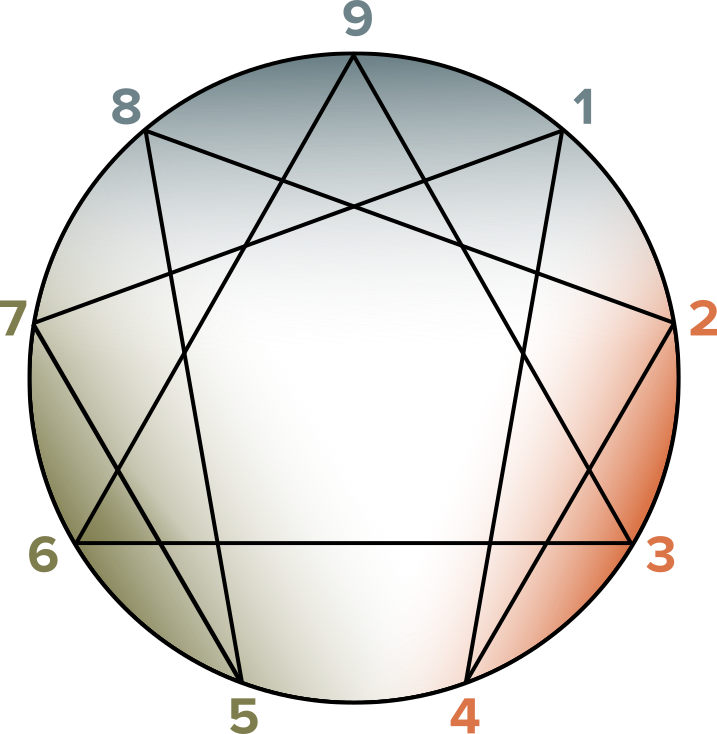
Throughout your life…
How have you been your own worst enemy?
And, how have you been your own best friend?
The Enneagram helps us understand those patterns more clearly.
It describes nine different ways people pay attention, find motivation, protect what matters, and respond when something feels at stake. Each pattern carries genuine strengths, hard-earned wisdom, and predictable blind spots.
This isn't about sorting people into boxes. It's about understanding a strategy well enough to use it on purpose, instead of it quietly using you.
Most of us have patterns that belong in both answers.
The patterns that help us can also become the patterns that limit us
UNDERSTANDING OUR PATTERNS
The Enneagram becomes most useful when it helps us see the fuller shape of a strategy.
Every pattern has strengths. Every pattern has blind spots. The same qualities that help us navigate the world can become overused, overextended, or disconnected from what a situation actually requires.
How has your pattern been your best friend?
The same strategies that help us navigate life often become some of our greatest strengths. Where has it helped you:
connect
create
persevere
care
accomplish
understand
contribute
How has your pattern become your own worst enemy?
Those same strategies can create problems when they become overused, rigid, or disconnected from what a situation requires. Where has the same strategy become:
rigid
exhausting
avoidant
reactive
controlling
perfectionistic
fearful
The question isn't whether a pattern is good or bad.
The question is whether it is serving the moment or simply repeating what it already knows.
HOW PATTERNS TAKE SHAPE
What began as adaptive can become automatic
Our strategies developed for a reason.
They helped us find connection, safety, belonging, identity, competence, certainty, or some way of navigating the world.
The challenge isn't having patterns.
The challenge begins when a familiar strategy becomes the only strategy we know.
01
Adaptive
The pattern carries real wisdom and serves an important purpose.
02
Automatic
With repetition, the pattern becomes familiar enough to operate without conscious choice.
03
Aware
Awareness helps us notice the pattern while it is happening. Choice becomes possible.
Every strategy carries wisdom.
The trouble is when the strategy becomes habitual.
The Enneagram describes nine recurring patterns of motivation and attention.
Each type sees something important.
Each type misses something important.
Each type brings gifts and struggles into the world.
Nine ways of paying attention
THE NINE TYPES

Attention
What do I notice when I first step into a room?
Motivation
What am I trying to feel, achieve, avoid, maintain, or protect?
Strategy
What response feels necessary when something important is at stake?
Questions people often ask
-
Only you can determine your Enneagram type. While there are online tests that can offer a starting point, they often focus on behavior. The Enneagram is fundamentally concerned with motivation and attention, which are easier to discern through reflection and conversation over time.
People often discover their type through a combination of listening to teaching, reading thoughtfully written descriptions, participating in panels, and noticing what consistently resonates across different seasons of life. For those who want additional support, a typing consultation can help surface patterns and offer a working hypothesis to explore further.
-
No. While the expression of your type can vary depending on context, stress, support, and self‑awareness, your core pattern of motivation and attention remains consistent. Growth within the Enneagram is not about changing types, but about loosening our identification with habitual patterns and expanding our capacity for choice.
-
This is a common concern. The Enneagram doesn’t put us in a box so much as help us recognize the box we’re already in, and how we might step out of it. When used with care, it can support compassion rather than reduction, helping us understand ourselves and others more generously.
-
Tests can be useful as a doorway, but they should be approached with caution. Because responses are influenced by mood, self‑image, and context, test results are best treated as information to reflect on rather than definitive answers. If you explore tests, look for those that emphasize motivation rather than traits or behavior.
Where would you like to go next?
Some people want to begin by exploring the nine types.
Others are more interested in how the Enneagram shows up in everyday life.
There's no required order. Begin wherever your curiosity is pointing.